

Written by Ioannis Kon. Neonakis
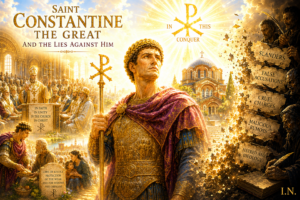
Saint Constantine the Great was fiercely opposed and relentlessly slandered—especially in the West—precisely because he changed the course of history and laid the foundations of the Christian Polity on earth, the Orthodox Romanía, providing a home and a homeland for the People of God. More than anything else, however, what disturbed and continues to disturb his opponents is his sanctity.
The principal accusation is well known: that Constantine the Great put his son Crispus to death in 326 A.D., and likewise his second wife, Fausta. Upon this dark allegation an entire anti-Constantinian edifice was constructed. “How can a man who killed his own son and wife be a saint?” is the question that has echoed through the centuries.
Constantine was first married to the noble Minervina, by whom he had his firstborn and dearly beloved son, Crispus. Political considerations, however, would eventually lead him to separate from Minervina and marry his second wife, Fausta, in 307 A.D., the daughter of his co-emperor Maximian. Together they had three sons—each of whom would later become emperor—and two daughters.
Constantine loved Crispus deeply. Crispus was exceptionally gifted, and Constantine regarded him as his worthy successor. He had already elevated him to the rank of Caesar and entrusted him with the administration of Gaul. Despite his youth, Crispus had achieved significant victories both on land and at sea, earning the absolute respect and admiration of the entire army.
Constantine the Great was not a cold political strategist who merely “used” Christianity to advance his political ambitions. His life and actions reveal a profoundly religious man, one who sought Christ from a very early stage, many years before his baptism. His relationship with his spiritual guide, the venerable Bishop Hosius of Corduba, his vision of “In this sign conquer” (In hoc signo vinces), his attitude toward the Church, his philanthropic legislation, and his willingness to submit major ecclesiastical controversies to conciliar judgment all testify to a man who did not regard faith as a tool, but rather, from an early stage, as Truth itself—a man undergoing a profound inner conversion and journeying steadily toward Christ.
Among the many incidents that demonstrate his complete estrangement from the old religion long before his baptism was his famous refusal to offer sacrifice to Jupiter Optimus Maximus on the Capitoline Hill in Rome during the celebrations of the twentieth anniversary of his reign (Vicennalia). According to Roman custom, the emperor was expected to lead a magnificent military procession to the Capitoline Hill and offer the prescribed sacrifices. Yet when the procession reached the foot of the hill, Constantine categorically refused to ascend and sacrifice. Instead, he publicly ridiculed the ceremonies and the idols. This action shocked and enraged both the Roman Senate and the people of Rome, who remained overwhelmingly attached to the ancient religion. Despite the furious reaction of the populace—who, according to reports, jeered him and even vandalized statues and images of the emperor—Constantine remained steadfast, disregarding the enormous political cost and revealing the depth of his inner transformation.
Inspired by his Christian faith, Constantine enacted dozens of humanitarian laws: state assistance for impoverished parents, the criminalization of infanticide, protection for widows and orphans, restrictions on divorce, protection of slaves from abuse and the facilitation of their emancipation, the abolition of crucifixion, the prohibition of facial branding, more humane prison conditions, the establishment of Sunday as a day of rest, and many other reforms.
One of his most significant reforms was the dramatic tightening of legislation concerning adultery. What had previously been treated largely as a private civil offense was transformed into a grave public crime punishable by death. Later, the penalty would be commuted to imprisonment. The law applied universally to all adulterers, regardless of social rank.
Only a few days after the enactment of this legislation, Fausta accused Crispus of assaulting her and engaging in an illicit sexual relationship with her. Constantine, as the lawgiver who was obliged to set an example by enforcing his own laws, ordered the arrest of his beloved son. Shortly thereafter, before any formal investigation had been completed and under circumstances that remain unclear, Crispus was found dead.
Three principal historians dealt with Constantine and his age: Eusebius of Caesarea, Lactantius, and Zosimus. Eusebius and Lactantius wrote in praise of Constantine, whereas Zosimus portrayed him as though he were the source of every evil.
Although Eusebius and Lactantius were contemporaries of Constantine, neither mentions these events. Lactantius, moreover, enjoyed a close relationship with Crispus and is even described as his tutor. It is difficult to imagine that a man so closely connected to Crispus would have remained a friend, supporter, and admirer of Constantine had the emperor unjustly and cold-bloodedly murdered his son.
Zosimus, by contrast, wrote much later—roughly 170 to 190 years after the events in question. He did not live through the period, nor was he ideologically neutral. He was a pagan historian who viewed Constantine as the chief culprit responsible for the abandonment of the traditional Roman religion. For Zosimus, Constantine stood almost at the very beginning of Rome’s decline: the man who overturned the old order and brought Christianity into the heart of the Empire. Thus, when Zosimus writes about Constantine, he is not merely writing history; he is presenting an ideological indictment. Precisely because his narrative is ideologically driven, it must be approached with great caution.
Virtually all the grave accusations directed against Constantine derive primarily from Zosimus. He claims that Constantine executed Crispus because he suspected a relationship between him and Fausta; that he then killed Fausta in an overheated bath; that he sought purification from pagan priests; that he embraced Christianity only because it offered forgiveness of sins; and that after rejecting the Capitoline rites he effectively abandoned Rome in favor of a new capital. It is a narrative constructed as a moral drama: crime, guilt, false purification, abandonment of the ancestral religion, and ultimately imperial decline.
Here lies the central problem. Later Western historiography, particularly from the Enlightenment onward, embraced Zosimus’ narrative because it conveniently served a broader thesis: that Christianity supposedly weakened Rome, that the Church corrupted political life, and that Constantine cynically used Christ to consolidate power. For centuries, any interpretation of the fourth century that sought to portray it as the beginning of Rome’s decline found in Zosimus a remarkably convenient foundation, often bypassing other sources, especially Eusebius. Yet this is not history. It is a modern prejudice.
At this point we must return to Crispus.
Orthodox tradition preserves a different account: that Crispus was the victim of a conspiracy. According to this understanding, Fausta, the mother of three sons whom she wished to see inherit the Empire—and who indeed eventually became emperors—had every reason to remove Crispus, the legitimate heir, from the line of succession. The accusation against him was false. Constantine, as a lawgiver who respected the law, could not simply ignore such a serious charge. Crispus was arrested pending investigation. Before the truth could emerge, however, he was found dead, likely at the hands of the very forces that had orchestrated the slander against him.
This interpretation cannot be presented as judicially proven fact, since we do not possess the complete dossier of the case. Nevertheless, it is the version most consistent with Orthodox tradition and with Constantine’s character. More importantly, it serves to undermine the certainty with which his accusers present their claims. The same is true regarding Fausta, for whose fate no definitive historical evidence exists.
In the case of Crispus, we possess no court records, no surviving imperial order of execution, no public decree issued by Constantine, no public execution, no clear indictment, and no legal file. There is simply no conclusive evidence that Constantine personally ordered the cold-blooded killing of his son.
What we do possess are later, often contradictory, and above all ideologically charged narratives. Yet upon this void an entire accusation has been constructed.
Sadly, this accusation has been repeated so often and with such force that it has influenced even parts of the Orthodox world. Some Orthodox Christians accept the possibility that Constantine bore responsibility, while insisting that this would not negate his sanctity. Repentance, they argue, is greater than any sin. Longinus became a saint. Paul the persecutor became Paul the Apostle. The Church does not canonize flawless biographies but transfigured persons. Others accept the execution itself but argue that it was not murder, merely the enforcement of a harsh law that Constantine, as emperor, was obliged to apply.
Yet this is not the heart of the matter. We should not casually accept Constantine’s guilt, because that guilt is by no means proven. On the contrary, it rests largely upon later accounts—above all those of Zosimus—which are openly hostile both to Constantine himself and to his work.
Orthodox tradition therefore seeks to make a distinction. It refuses to allow pagan and modern hostility to be transformed into “historical certainty.” It refuses to accept that the founder of Christian Romanía was a cynical, bloodthirsty criminal simply because such a portrayal serves the Western narrative of “Constantinianism.”
For this is the essence of the matter. The campaign against Constantine the Great is not merely historical. It is theological. It is civilizational. It is a campaign against Romanía itself—against the possibility of a polity that is neither a pagan empire nor a godless modern state, but a Christian, Christ-centered Polity upon the earth.
This is what they never forgave Constantine for. They never forgave him for allowing the Empire to be baptized in the light of Christ.
And so Constantine had to be transformed into a “murderer”: so that he could not be a saint; so that he could not be Equal-to-the-Apostles; so that he could not be the founder of Christian Romanía; so that the modern Romeos could not look to him as the father of his political and civilizational inheritance.
The restoration of Constantine the Great, therefore, is not merely a historical correction. It is an act of remembrance. It is the restoration of Romeosyne. It is a refusal to accept uncritically the hostile narrative of its opponents.
Constantine the Great was not sinless; no human being is. Yet he was holy. He turned history toward Christ. He granted freedom to the Church. He laid the foundations of Christian Romanía. He demonstrated that political power can kneel before Truth.
That is why he remains Great.
That is why he remains a Saint.
And that is why he is rightly regarded as the forefather of the Romeiko world—our forefather.
Holy Constantine the Great, Saint of God, pray for us all and for your beloved Romanía!