

Written by Ioannis Neonakis
The song “Ferto,” which will represent Greece this year at the Eurovision contest, has sparked a variety of reactions. Yet, beyond a superficial reading of its lyrics and of the overall concept of the work, we ought to approach more deeply the social and existential context within which it was born.
We shall not dwell on the simplicity of its language and music, on the lack of depth and of profound meaning, on the pervasive irony and the constant “trolling,” which essentially amounts to the use of humor as a defense mechanism and as a search for immediate gratification.
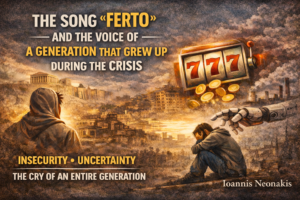
In our view, this song is not a hymn to gambling, consumerism, or greed, as it may initially appear. Rather, it is primarily the anguished cry of a generation (to which its creator, Akylas, also belongs) that grew up during the prolonged economic crisis, was deprived of fundamental opportunities, saw its expectations collapse, and today struggles daily for survival, without a clear prospect for the future.
Behind the desire for money, success, and material security lies a deep wound: insecurity, uncertainty, and the fear that life may stagnate or regress. Phrases such as “what we were deprived of in the past,” “so that nothing will be lacking again,” and “I buy to fill the gaps” reveal precisely this lived experience of a generation that grew up watching its parents being tested while its own future was shrinking.
At the same time, the song also reflects a deeper cultural void: the loss of meaning and orientation within our society. When society offers no vision, when education fails to inspire, when the state does not create real prospects, then the youth seek outlets wherever they can find them.
Today, moreover, the anxiety becomes even greater as the world enters a new technological era. Artificial intelligence, automation, and robotics are shaping a future in which many young people fear they may become unnecessary to the system. This uncertainty generates stress, pressure, and at times extreme expressions of desire for success and security.
For this reason, instead of confronting such artistic phenomena with rejection, we ought to read them as social symptoms. The artist expresses—perhaps unconsciously—the anxiety of an entire generation.
The real question, therefore, is not whether we like a song, but what kind of society we are creating for our young people.
Greece needs a new vision of life, hope, and perspective. It needs an education that cultivates persons rather than merely skills, a society that offers meaning, and a state that creates opportunities.
Our youth do not deserve criticism; they deserve a future.
And this future can be born only when we rediscover our roots, our identity, and the civilization of Romeosyne, which sees the human being not as an isolated individual or unit, but as a person endowed with value and destiny.
Ioannis Kon. Neonakis