

Written by Ioannis Neonakis
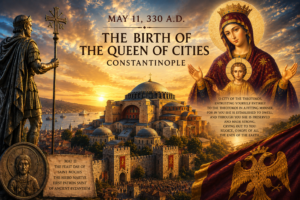
On May 11th, 330 A.D., Saint Constantine the Great inaugurated with great splendor the Nova Roma, the New Rome – Constantinople, the new capital of the Roman Empire, the new capital of Romanía. This day does not merely constitute an important historical event. It stands as one of the supreme moments of world history. For on that day, not simply a new capital was born. A new civilization was born. A new way of perceiving the world. Romeosyne.
Tradition preserves that Saint Constantine the Great, while tracing the boundaries of the City, was following an Angel of the Lord who indicated to him the points to be marked. And this is not accidental. This tradition reveals something far deeper. Constantinople was never regarded as an ordinary city. It was a city with a metaphysical destiny. A city born within the light of the Cross and dedicated from the very beginning to the Most Holy Theotokos, her great protectress and shelter.
For this reason, the Apolytikion of the Dedication of the City proclaims with awe: “The City of the Theotokos fittingly entrusts its very foundation to the Theotokos.” And it continues: “For in her it has been established to dwell, and through her it is preserved and strengthened, crying out unto her: Rejoice, O Hope of all the ends of the earth.”
The truly astonishing element is this: the City entrusts its very existence to the Theotokos. Its identity, its mission, its historical course cannot be understood apart from this relationship.
Neither was the choice of May 11th accidental. That day coincided with the memory of Saint Mocius, the first great martyr and patron saint of the ancient city of Byzantium, upon whose site the Queen of Cities would later be built. Saint Mocius had suffered martyrdom there by beheading on May 11th, 288 A.D., during the reign of Diocletian. Thus, Saint Constantine the Great, by choosing the day of the martyrdom of the local saint for the inauguration of the new capital, “baptized” the new City within the Christian tradition and united her to the blood of her martyrs.
Even more symbolic is the fact that the Church of Saint Mocius was erected by Constantine the Great directly upon the ruins of the ancient Temple of Zeus. The new capital was being born upon the ruins of the old world. Christianity was no longer merely a persecuted faith, but the new center of meaning for the inhabited world.
And Constantinople did not remain merely within the memory of Saint Mocius. From the very beginning, the entire City was dedicated to the Most Holy Theotokos. The Panagia became the great protectress and the “Champion General” of the City.
Constantinople was not merely the capital of an empire. It was not simply the administrative, political, military, and economic center of Romanía. It was the heart of the Genos (sic) of the Romeoi. It was the center of an ecumenical commonwealth, where different peoples coexisted under a common spiritual and cultural identity. It was the living historical manifestation of Romeosyne.
There rose Hagia Sophia, not only as a magnificent architectural achievement, but as the symbol of an entire worldview. There developed the theology of the Holy Fathers, the liturgical life, and the Romeike education that gave new meaning to the history of the world. There Hellenism, Roman ecumenicity, and Orthodoxy were united, creating that reality which we call Romeosyne.
And though centuries have passed, and though present inhabitants are of another faith, Constantinople remains and shall forever remain the eternal capital of Romeosyne. She remains the memory, the conscience, the cohesion, the symbol, and the hope of our Genos – the Pious Genos of the Romeoi. For the City was never merely a geographical location. She was, and remains, a way of life, a civilization, faith, and continuity.
And perhaps for this very reason, even today, deep within the soul of every Romeos, Constantinople does not belong to the past. She belongs to the present and to the future.