

Written by Ioannis Kon Neonakis
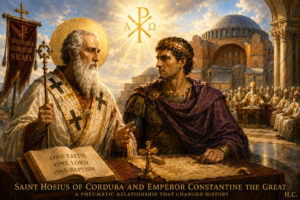
There are certain figures in history who stand almost silently in the background. They do not dominate the books, they are not frequently mentioned in public discourse, and yet, without them, the history of the world might have taken an entirely different course. One such man was Saint Hosius, Bishop of Corduba (Cordova) in Spain — the man who stood beside Constantine the Great during one of the most decisive periods in world history: the transition from the pagan world to Christian Romanía.
If we truly wish to understand the person of Constantine the Great more deeply, we must also pause attentively before the figure of this holy elder. For Saint Hosius was not merely a “counselor” to Constantine. He was one of the great spiritual personalities — perhaps the most important among them — who guided Constantine along his gradual inner journey toward Christ.
Very often, we almost mechanically identify faith with the act of baptism itself: “He was baptized, therefore that is when he believed.” Yet our Orthodox tradition does not perceive the mystery of repentance and divine knowledge in such a simplistic manner. The human heart may journey toward God for many years before the final step is taken. And it appears that this is precisely what Constantine the Great experienced.
One point that deserves particular attention is the following: many portray Constantine as a cold political realist who merely “used” Christianity for reasons of power. Such an interpretation is exceedingly superficial. For first of all, it fails to explain something fundamental: how is it possible — unless there had been a profound and overwhelming inner conversion — for an all-powerful Roman emperor, raised within the worship of Sol Invictus and the traditional imperial order, to turn so deeply and existentially toward a new and, until then, persecuted faith?
Furthermore, how can the famous vision before the Battle of the Milvian Bridge in 312, the appearance of the Christogram, and all that followed, be understood unless there already existed an inner spiritual foundation? Clearly, this was not some sudden “magical event.” It was most likely the culmination of a deep interior search. And this is precisely where the role of Saint Hosius emerges.
The sources show that Hosius stood very close to Constantine already during the years 312–313. This was not a casual acquaintance. The emperor entrusted him with critical ecclesiastical missions, mediations, and even the administration of financial resources. This demonstrates that Constantine did not see in him merely a distant, formal bishop, but rather a trusted man of immense spiritual gravity.
It is worth dwelling upon something extraordinary concerning the Saint: Hosius was a man of the persecutions. He did not emerge from a comfortable Christianity allied to power. He had confessed his faith amid the fires of the persecutions during the Tetrarchic period. He was a man who knew what it meant to risk one’s very life for the Name of Christ. And such a man could hardly become a mere instrument of administrative politics.
Constantine saw in the person of Hosius a holiness that stood apart from others, an Orthodox authenticity and truth that he could no longer find within the decaying pagan world surrounding him. The gods of the empire no longer offered him meaning. By contrast, the ethos of the Christians — embodied so profoundly by Hosius — revealed another path before him.
Constantine’s trust in Hosius became so great that he appointed him responsible for the distribution of imperial financial aid to the suffering Churches of Africa. Later, when the Arian crisis erupted, Constantine once again turned to Hosius, “distinguished in faith and life,” sending him to Egypt in an effort to resolve the crisis through mediation and dialogue. These efforts ultimately proved fruitless, and upon returning, Hosius persuaded the Emperor of the necessity of a Council. He had understood that the issue was not a mere scholastic quarrel, but a deep ecclesiological and soteriological wound. Thus, the Emperor sought not merely a political solution, but spiritual discernment and doctrinal precision.
Constantine convened and supervised the Ecumenical Council of Nicaea in 325, and Hosius emerged as the most prominent episcopal figure standing beside the Emperor. Constantine provided the historical stage; Hosius, in a certain sense presiding among the bishops, helped shape the proper ecclesiological content. Many assume that Constantine’s sole concern at that moment was “the unity of the empire.” Certainly this mattered greatly to him. But had the matter been purely political, he could simply have imposed a superficial reconciliation. He possessed the absolute power to do so. Nicaea would not have been necessary. The term homoousios would not have been necessary. Nor would the tremendous confrontation with Arianism have been necessary. Yet, as a profoundly believing man, Constantine desired to define and safeguard the very path of salvation itself.
The presence of Hosius at the First Ecumenical Council is almost symbolic for the entire later course of Romanía. On the one hand stood the Emperor, and on the other the Bishop — not in a relationship of subjugation, but of synergy, cooperation. Neither Caesaropapism nor theocracy, but the Romeike “synallēlia” (sacred concord between imperial authority and the Church), that harmonious cooperation which would later give birth to the civilization of Christian Romanía. Orthodox Romeike synallēlia is not servile submission, but the concord of distinct responsibilities.
This became even clearer later in Hosius’ famous letter to Constantine’s son, Emperor Constantius, when the latter attempted to interfere in ecclesiastical affairs and impose Arianizing solutions. Hosius defined the boundary: the emperor governs the empire, while the Church governs ecclesiastical matters. “Do not involve yourself in ecclesiastical affairs.”
The very same man who collaborated with Constantine the Great for the sake of Nicaea became also the man who defined the limits of imperial authority. He articulated the Romeike principle of synallēlia: neither servility toward political power, nor revolutionary hatred against it, but discernment, hierarchy, cooperation, synergy, and limits — all for the good of the People of God, whom both authorities are called to serve in parallel.
The relationship between Saint Hosius and Saint Constantine the Great was the encounter of a searching emperor with a true man of God. And through this encounter, not only was Constantine’s personal salvation shaped, but a Christian Empire was also founded: Christian Romanía.
For this reason, Saint Hosius, Bishop of Corduba, is not some insignificant “detail” of history. He is one of the silent roots of our world.